On Sunday 11 October, thousands of people walked from the Glorieta de La Minerva to Casa Jalisco, the governor's residence, carrying signs about the water in their taps: cloudy, smelling bad, full of sediment. The week before had given warning. Riot police had already dispersed two spontaneous neighborhood protests over the same brown water, and students at the ITESO shouted Governor Pablo Lemus out of their university[65]. When part of the Sunday crowd pulled down the metal fence, the police answered with tear gas and water cannons, and children and older people were among those hit[64]. The government counted 39 arrests that night. The families who organized the march counted 51[65].
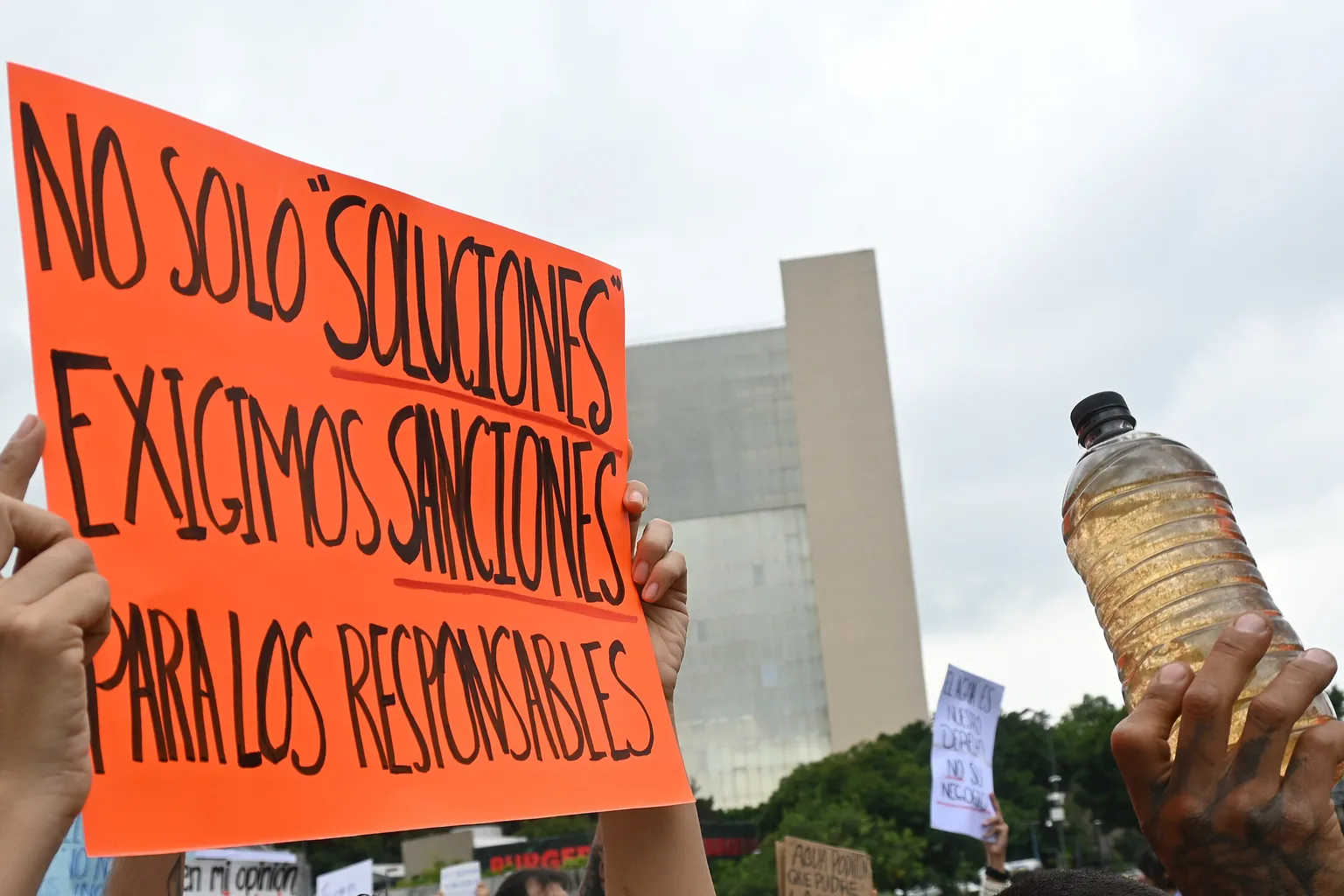
Nobody in that march was protesting a server farm. Jalisco's water crisis is older than the AI boom and has causes of its own, and I won't hand a governor an alibi by blaming datacenters for rain that doesn't fall and pipes nobody repairs. I open with the scene anyway, because it prices everything that follows. Water in Mexico has reached the temperature where people get gassed over it. Any industry that adds demand to a basin in that state inherits the fight, whatever its meter says.
Three weeks later, Querétaro's secretary of sustainable development, Marco Antonio Del Prete, told reporters the state would guarantee electricity to every datacenter that wanted to come. He counted between 18 and 20 of them and more than US$12 billion in announced or committed investment[1, 69]. He said it in the tone of a man reading a weather report. The electricity was the whole answer.
Two thousand kilometers north, the same news cycle was counting votes. Datacenter measures had reached the ballot in more than forty-five American towns and counties, and restrictions won almost every one that finished counting[2]. NBC's exit poll found 76 percent of voters would oppose a new datacenter in their own community[3]. Texas elected a governor who wants a statewide moratorium, Georgia elected one who favors it too, and capital that gets told no in one county goes looking for a county that says yes[4, 5, 6]. Querétaro had its answer ready before anybody asked.
My argument is that what is queuing at the border is the maquila bargain again, the same deal Mexico has run for sixty years, with water and megawatts standing in for labor hours. It is a worse bargain than the original, because this time the payroll almost disappears while the bill, paid in water and megawatts, lands on us. I've spent my career one floor up from the last version of this building. I'll show you the ledger from that first run, then the new one, and then the part of the stack I think is still ours to keep.
A door closed in 1964
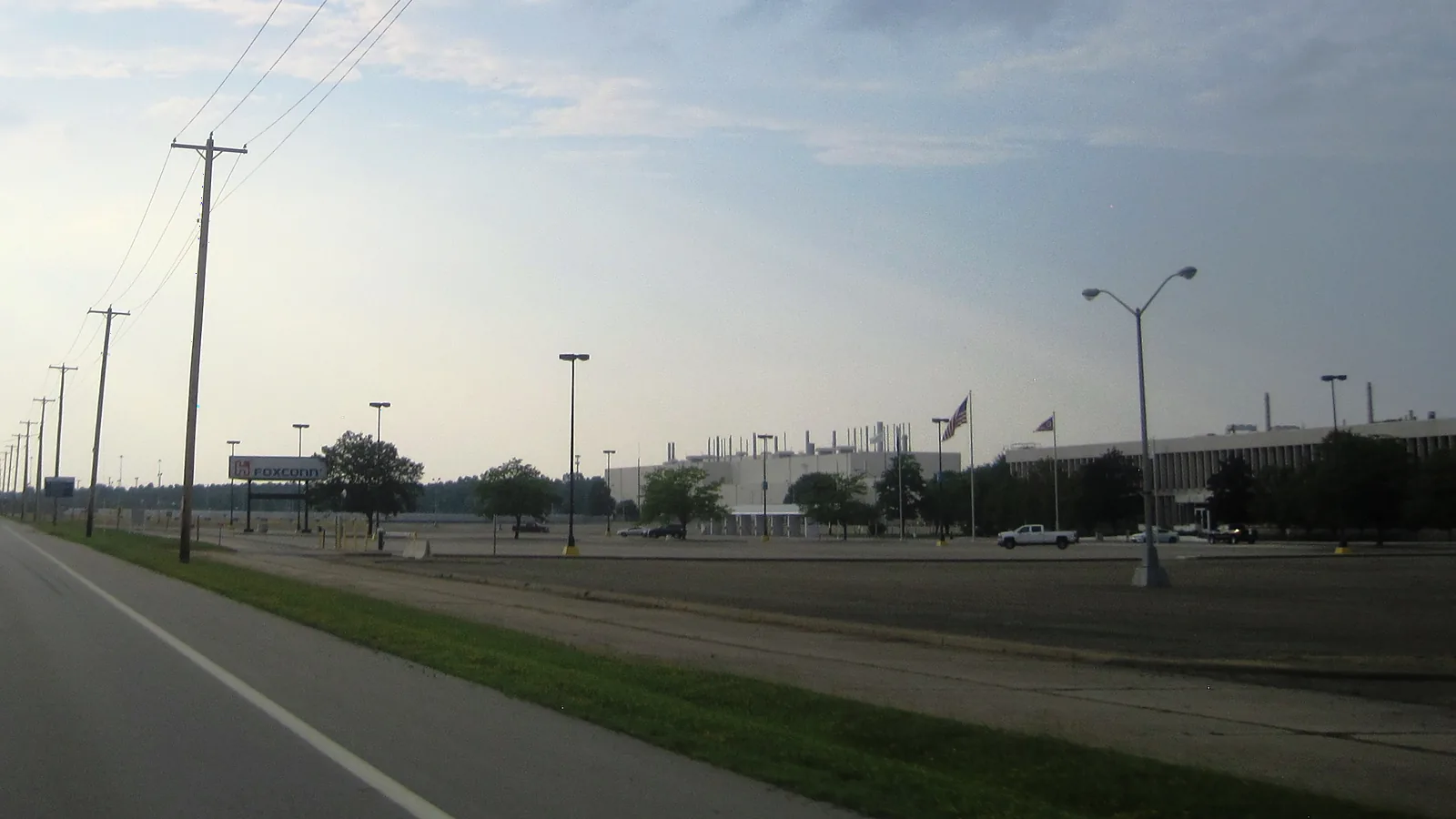
Section titled "A door closed in 1964"Mexico has run this play before, and it started the same way, with a door closing on the other side of the border. Washington ended the Bracero program in December 1964, and the men who had crossed legally to pick cotton and lettuce came home to border towns with nothing waiting for them[7]. Five months later the federal government announced the Programa de Industrialización de la Frontera Norte, and the first maquiladoras opened in Ciudad Juárez in 1966, inside the country's first industrial park, built to the specifications of the American companies that would rent it[8, 9].
The bargain was simple to state. Mexico supplied land, cheap hours and a border, and the plants supplied payroll. Sixty years later that payroll is 3.17 million people inside the IMMEX program[10]. The door closing now is a different one. What Mexico is being asked to supply has changed. The bargain underneath hasn't.
The best case we have
Section titled "The best case we have"Judge the maquila model by its best student, and in Mexico that is the car industry. It exports 87 percent of what it builds, mostly to the United States, and in 2025 those exports were worth US$185.8 billion[11, 12]. Every time someone in a press conference says "nearshoring", this is the picture behind their eyes.
So walk into the building. The people on the assembly line at the big branded plants earn well by Mexican standards, close to twice the manufacturing average[13]. The trouble is how few of them there are, which the notes on the chart show.
Data
| branch | MX$ per month |
|---|---|
| All manufacturing | 18131 |
| Autoparts | 21995 |
| Vehicle assembly | 35360 |
The census explains the chart. In 2018, 8.9 percent of the industry's workers stood in assembly and 88.5 percent stood in the parts plants, where the real hourly wage fell 4 percent between 2003 and 2018[14]. The good wage is real. Most people in the industry are standing somewhere else.
Then you follow the parts. Between 75 and 90 percent of the components that go into Mexican autoparts are imported[15], the Mexican content of Mexican exports has been sliding for years as foreign content grows[16], and by the input-output studies the sector has the weakest ties to the rest of the economy of anything except mining[17, 18]. Inputs arrive from abroad, a share of the value gets added by Mexican hands, and the finished goods and most of the margin leave again. What that describes is an island.
And the island turned out to be rented. Section 232 tariffs of 25 percent have hit Mexican cars since April 2025, Washington declined to renew USMCA at its July 2026 review, and the jobs had started leaving before any of that[19, 13]. Parts plants have shed workers every month since March 2024, assembly every month since January 2025, and in the year to August 2026 the industry accounted for 18,256 of the 40,727 manufacturing jobs Mexico lost[13]. Twenty straight months of losses on the assembly line is what a decision in Washington looks like from a shop floor in Guanajuato.
The ladder ends at technician
Section titled "The ladder ends at technician"The companies did build a ladder, and I want to give them credit for it. BMW's dual program in San Luis Potosí has graduated more than 570 apprentices and hired 95 percent of them, Volkswagen has turned out nearly 6,000 technicians over sixty years, and Nissan runs a corporate university with official degree validity[20, 21, 22]. Operator to technician to supervisor is a real path, built by the companies themselves, and it works. Above supervisor, the ladder stops. The engineers who design the car, the platform and the factory get recruited as engineers, mostly somewhere else.
I know the view from one floor up, because that is where I went. By the time the pandemic made remote hiring ordinary, I had nearly a decade of shipped work behind me, and through First Factory, through Nagarro, then at PayPal and Zillow, I wrote production code for American companies from Mexico City. That move tripled what Mexican companies had been paying me, for about a tenth of the workload. I would make it again tomorrow. The pitch never changed across the 47 roles 35 recruiters sent me during my last job search: a senior title, an American product, American hours, "LATAM" in the location field, and a salary band built around what I cost here.
Data
| offer | US$ per year |
|---|---|
| Contract platform, US$6,500 a month | 78000 |
| Staff full stack, scoped to LATAM | 100000 |
| Agentic AI engineer, Mexico City | 110000 |
| Median US software developer, May 2025 | 135980 |
The band topped out below the US median of US$135,980[23], and nobody on those calls hid the arithmetic. Big companies run the same play in public documents. Capital One closed its purchase of Discover in May 2025, began telling Illinois about 1,139 job cuts in February 2026, and by October its new Mexico City office was posting site reliability roles for "the first cohort of engineers in CDMX"[24, 25, 26, 28, 29]. No filing says a desk in Riverwoods became a desk in Reforma; I can only lay the dates side by side. Avasant's 2026 report calls the new engineering centers in Mexico City, Guadalajara and Monterrey a move away from cost arbitrage toward higher-value work[32]. The car industry made that same promise in the nineties. This is the maquila bargain carried into software: hosting someone else's product, on someone else's margin. The roadmap, the product calls and the equity stayed where they always were. That is the autoparts tier with better chairs, and the way off it is the one the plants never found: owning the design, the product or the customer.
A floor, at least
Section titled "A floor, at least"None of this means the car industry failed the people inside it, and I won't pretend otherwise. Directly hired auto workers are formal workers, with IMSS, Infonavit, profit sharing and a pension. When Mexico banned outsourcing of core work in 2021, the plants put those workers back on their own payroll, average pay rose about 10 percent, and no measurable jobs or output disappeared[33]. Workers can now bring labor violations to a trade tribunal under USMCA's Rapid Response Mechanism, and the cases are public, from the destroyed union ballots at GM Silao to back pay for 154 fired workers at Tridonex[34, 35]. The industry built a floor, and for millions of people without a degree it is the best formal job this country offers. It never became a ladder, because nobody here owns the design, the brand or the customer. Each of those protections came from a law or a trade agreement. None came from an operator deciding to be generous.
The payroll almost disappears
Section titled "The payroll almost disappears"Now watch what happens when the tenant stops being a car plant and becomes a rack of GPUs. The industry association counted 115.5 megawatts of datacenter capacity operating in Mexico in 2024, 235 in 2025 and 279 by April 2026, with another 205 under construction. Its own projection reaches 1,730 megawatts by 2031, and Querétaro already holds about 72 percent of what is built[36, 37]. The last point on the chart is that projection, not anything poured.
Data
| year | MW |
|---|---|
| 2024 | 115.5 |
| 2025 | 235 |
| 2026 | 279 |
| 2031 | 1730 |
Then count the people, and watch each line lose a couple of zeros.
- All IMMEX establishments, Aug 2025
- 3,177,061
- Vehicle assembly, Aug 2026
- 104,648
- CloudHQ campus, permanent jobs promised
- 900
- Microsoft Querétaro facility, 2025
- 64
CloudHQ's US$4.8 billion campus in Querétaro was announced from the presidential podium. Microsoft's own fact sheet says its Querétaro buildings employ about 64 people[38, 39]. A US$4.8 billion campus is a construction project with a security desk attached, and the security desk doesn't need a dual training program. Local content rules can't fix that, because a datacenter has almost nothing to make locally. What Mexico ships from these buildings is megawatt-hours, cubic meters of water and hectares of land, each with a permit attached, plus a small crew to keep the machines breathing. Labor hours were the old export.
Ohio already ran the other half
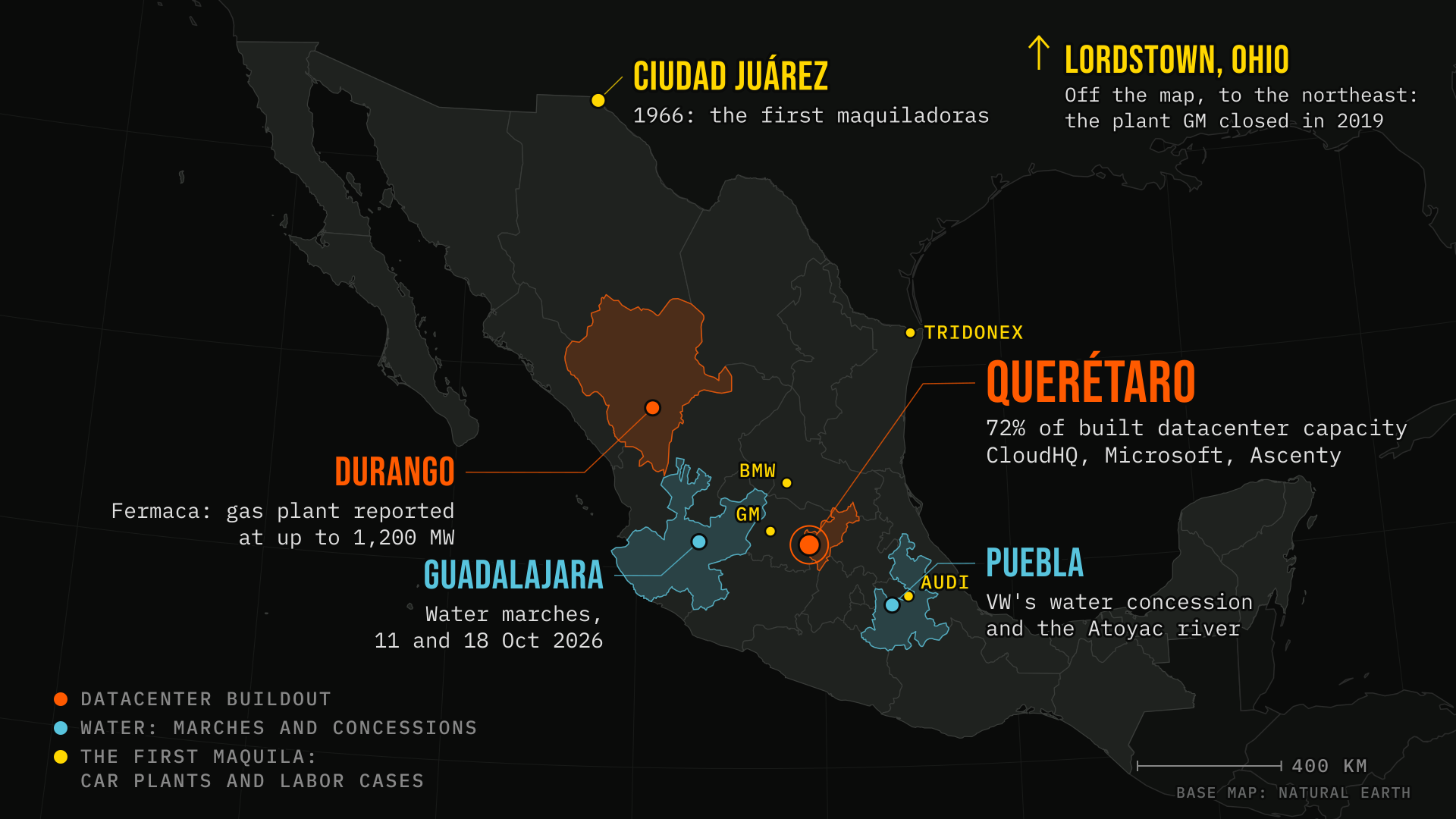
Section titled "Ohio already ran the other half"The closest preview of this bargain is a state that lost the last one, partly to us. By 2016 Ohio had lost half of its peak manufacturing jobs, and some of that came south. Lordstown is the cleanest case: General Motors' plant there employed 4,500 people in 2017, the last Chevrolet Cruze left the line in March 2019, and GM kept building the Cruze in Mexico for other markets[40, 41, 42]. Some share of what Ohio lost sits on the IMMEX payroll counted earlier. Nobody can say exactly how much.
Then Ohio took the datacenters. The state has committed at least US$2.3 billion in sales-tax exemptions for them, and the incentives run on secrecy: in 2017 its Tax Credit Authority approved US$37.1 million for a project known only as Sidecat, before anyone outside the room knew it was Facebook[44, 45, 46]. The bill came to the households. The average Ohio electricity bill rose more than 53 percent in five years, against 32 percent nationally, and in the grid operator's last three capacity auctions, forecast datacenter load accounted for US$21.3 billion of US$47.2 billion in costs, a charge that reaches every meter on the grid[47, 48]. On 3 November, Ohio held more datacenter ballot fights than any other state. Ten cities passed outright bans on large campuses, and one town turned down two buildings with 81.6 percent of the vote[49].
Lordstown came back too, in a form worth studying. SoftBank bought the old GM plant from Foxconn, and Foxconn now runs it to build datacenter equipment for Stargate, with a county commissioner expecting up to 2,000 jobs at the plant[50, 51, 52]. Even inside the AI boom, the payroll sits with whoever builds the machines, and the bill goes to whoever hosts them. Querétaro is signing up for the hosting half. Ohio's towns at least got a line on the ballot. Del Prete's guarantee of electricity came at a press conference.
The water bill arrives twice
Section titled "The water bill arrives twice"When Querétaro was asked how much water its datacenters drink, Del Prete answered that it isn't his department. "El consumo del agua no es responsabilidad de la Sedesu, ni siquiera de la CEA, porque son aguas nacionales", he said in October, because the national water commission assigns the volumes. The state agreed with the industry association to collect consumption through an annual operating report, with a trial measurement this year and the first public numbers in 2027[53]. By then several campuses will already be running, and a number published after a campus is energized can only describe what happened. It can't be a condition for the permit.
What exists today is paper. Reporters at CLIP found Microsoft with access to 25 million liters a year through a partial water-rights transfer, and Ascenty with about 3.5 million liters a year at its second site[54]. None of these documents states how many cubic meters a campus actually withdraws. Mexico already knows what a cluster of industrial water users does to a basin, and the lesson comes from car plants. Volkswagen has held a concession for 1.5 million cubic meters a year near the Atoyac river in Puebla since 1996[55], and Audi's newer plant in San José Chiapa, the first car plant certified under the Alliance for Water Stewardship standard, holds well titles for about 502,000 cubic meters a year[56, 57]. I put the paperwork side by side.
| Holder | What the paper says | m³ a year |
|---|---|---|
| Ascenty, second Querétaro site | supply arrangement | ~3,500 |
| Microsoft, Querétaro | partial rights transfer | 25,000 |
| Audi, San José Chiapa | two well titles | ~502,000 |
| Volkswagen, Puebla | concession since 1996 | 1,500,000 |
Every row is an authorization. On paper, the datacenter volumes look small next to the car plants. Paper is the whole problem. Each of those numbers is a ceiling someone was allowed to reach, and nobody publishes the meter. The river only sees the sum.
Then there is the water you can't see, because the electricity carries it. About 60 percent of the power injected into Mexico's grid in 2024 came from combined-cycle gas plants[59].
Data
| technology | % |
|---|---|
| Combined cycle | 60.41 |
| Conventional thermal | 8.01 |
| Coal | 3.68 |
| Gas turbines | 3.41 |
| Hydro, wind, solar, nuclear, geothermal and other | 24.49 |
At the official emission factor of 0.444 tonnes of CO₂ per megawatt-hour, a campus drawing 100 megawatts around the clock puts out roughly 389,000 tonnes a year[58]. That is an illustration at the national average, not a measurement of any project. A campus that buys clean-energy certificates still pulls from this grid.
When the grid can't arrive on time, the campus brings its own fire. Microsoft holds a conditional environmental authorization for seven natural-gas generators at its second Querétaro site, about 10.5 megawatts of start-up load, while it waits for a CFE connection its own filing doesn't expect before the second quarter of 2027[60]. In Durango, Fermaca's project began as a 350-megawatt gas plant with a 160-kilometer pipeline, became a land decree with hectares set aside for fuel cells, and by August 2026 was being reported at up to 1,200 megawatts[61, 62, 63].
And here is the part that should keep a Mexican reader up at night. In my own dossier on this buildout, cut off on 7 November 2026, I couldn't find a single numbered CFE or CENACE interconnection agreement for any named project. Not one public number ties the megawatts in the press releases to a feeder on the grid. That is a statement about public records, and a company may well hold one in a drawer. But set the pattern side by side: a water consumption figure nobody publishes, a guarantee of electricity issued at a podium, gas generators authorized while the interconnection waits, tax breaks approved for a project with a code name. This is how the old machinery speeds the new scarcity up. Each permit looks reasonable on its own page, each signature belongs to someone doing their job, and the sum of the deals gets written down nowhere anyone can check. By the time the basin or the grid shows the bill, everything that caused it is stamped, permitted and legal.
What the march got there first
Section titled "What the march got there first"Go back to Guadalajara for a moment. The march was about cloudy water in the tap, and nothing in the record ties it to a server farm, and I mean to keep it that way. But watch what the fight did next. A week later, on 18 October, around ten thousand people marched again, this time demanding the revocation of the governor's mandate, and Lemus called the day a civic exercise[66]. The movement didn't wear itself out on tear gas. It grew a political demand.
And Guadalajara is only the loudest corner of a wider map. The Bajío, the farm belt that feeds this country, has shown signs of water stress for years, with aquifers in drawdown, and the economists who watch the region now name the tech industry and its datacenters as the new demand arriving on top of agriculture[67]. Querétaro, which holds 72 percent of the country's built datacenter capacity, sits in the middle of that map. The smaller warnings have been accumulating for years: spontaneous cutoffs in neighborhood after neighborhood, wells drilled deeper, and an industrial corridor like the Atoyac basin, where the plants held their permits and the river died anyway[55]. None of it produced a megamarch. It didn't have to. The water table did its counting quietly.
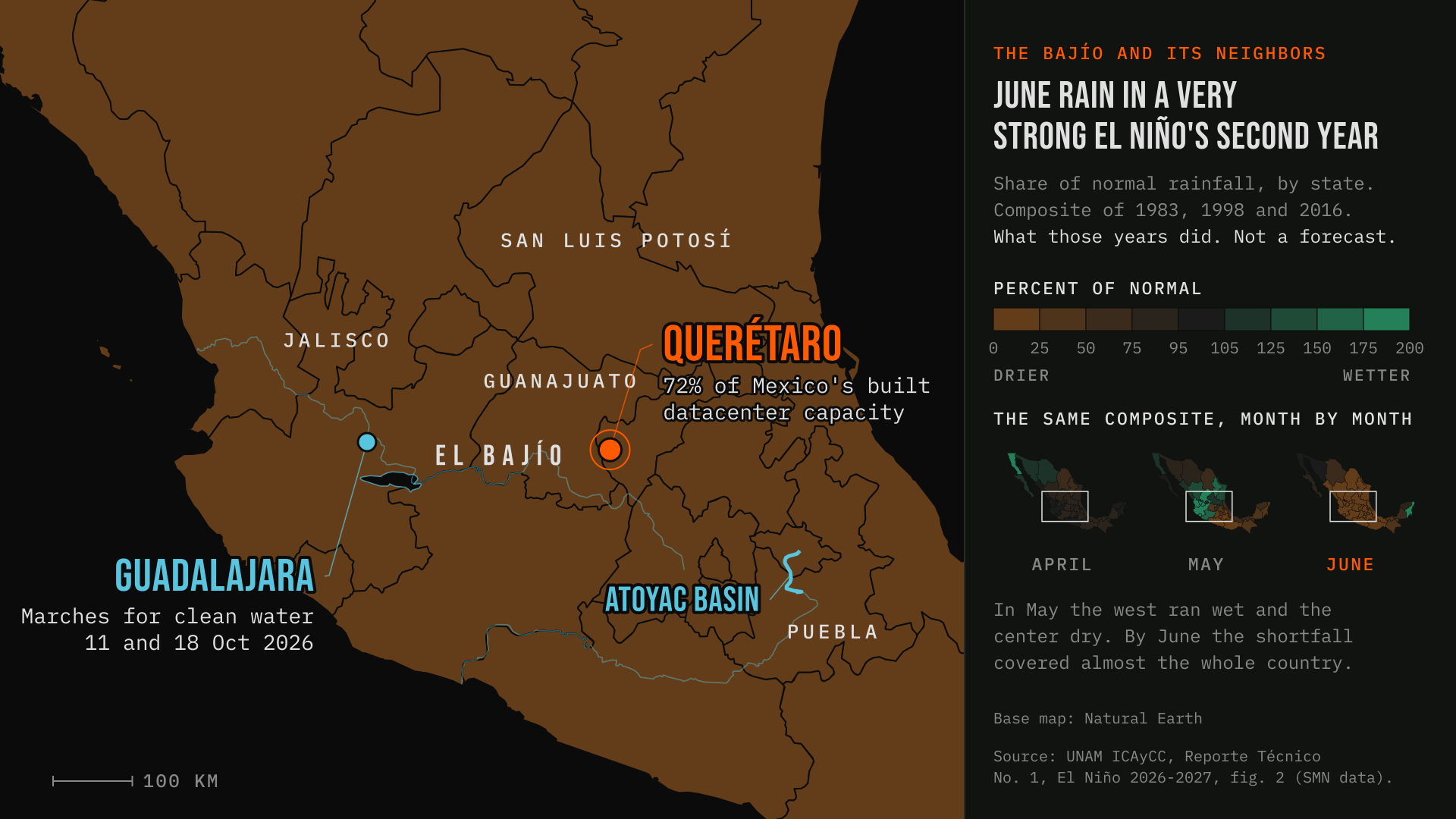
The weather is about to join the argument. In November, UNAM's atmospheric scientists, working with the national weather service and Conagua, published the first technical report tracking the El Niño event of 2026 and 2027. Their forecast puts a likely drought in the spring of 2027, with below-normal spring rainfall across the center and south of the country[68]. The campuses now under construction will be energized into exactly that spring.
Jalisco holds 7.2 percent of IMMEX employment[10], and the first campus to ask for a large water title in a state with two megamarches in living memory won't be negotiating with a regulator alone. The people in those marches don't know yet that the bill for a few basins' worth of megawatts is being signed in another state. That is the most dangerous part of the arrangement. The fight starts when the taps fail, years after the paperwork. And the forecast says the taps will be tested harder next spring.
What would make it something else
Section titled "What would make it something else"The car industry's history says this price gets set by law, not by sustainability pages. The outsourcing ban and the USMCA enforcement cases moved more money into workers' pockets than any voluntary pledge. If the GPU maquila is going to pay for the water and the gas it takes, the price will come from permit conditions, disclosure rules, and the same rapid-response logic applied to what a campus actually does: water titles, generator hours, grid connections.
Then there is the part of the stack that stays here. The concrete, the chips and the models arrive from elsewhere. The routing, caching, budget caps, approval gates, data residency, and the software a Mexican customer actually touches can be built here, by people who live here, and that is where margin compounds. Two hundred seventy-nine megawatts of poured floor is worth less to this country than the code that decides what runs on it. It is the only part of this buildout a Mexican engineer can own outright, and nobody counts it in the press release.
None of that happens unless somebody counts. Three public numbers would change this, and all of them are boring. Annual cubic meters per campus, because a company-wide average hides the basin. Generator runtime hours, because nameplate capacity says nothing about what burned. The interconnection agreement number and the megawatts actually energized, so a press release can be checked against a feeder. Querétaro set 2027 as its own deadline for the first water figures. Holding the state to that date is the only lever a neighbor has without hiring a lawyer.
The maquila taught Mexico the difference between hosting and owning, and the lesson took sixty years. The GPU version will arrive faster and forgive less, because water doesn't wait for the next six-year term.
On 11 October in Guadalajara, people got gassed over water nobody had told them was spoken for. They marched again a week later, ten thousand strong, asking for the governor's job. By the time the third march happens, the paperwork for the next few hundred megawatts will already be signed. The ask of this essay is the boring one: make them publish the meter, and make the permits carry the price.
I run inference on cards I own, in a rack I can walk to, for a company I founded here. It's a small thing next to a gigawatt campus, and it's the part of the stack I'd rather argue about than the jobs number in somebody's announcement.
Sources and limits
Section titled "Sources and limits"
The 2026 employment and wage figures come from Banco Base's October 2026 automotive report, which cites INEGI's August 2026 manufacturing survey. Banco Base reuses that PDF's filename across editions, so a later visit may show newer months. The recruiter figures come from my own job-search tracker for June and July 2026. They describe the offers I received, not the market, and I don't name the companies that sent them. The contract figure is US$6,500 a month times twelve. The water volumes are authorizations, concession ceilings and rights transfers, never metered withdrawals. The Ohio section started from Economics Explained's video on Ohio's datacenter boom; every figure in it is cited to the reporting or filing behind it, and claims from the video I couldn't trace to a primary source were left out. The datacenter permits, generator authorizations and interconnection search come from my own public-record dossier on Mexican AI infrastructure, cut off on 7 November 2026, which keeps the underlying filings. The photograph of the march is  by Wikimedia Commons user Salvador alc, taken that Sunday and used here cropped under
 CC BY 4.0. The Lordstown photograph is
 by Wikimedia Commons user Mr. Matté, taken in June 2024 and used here cropped under CC BY-SA 4.0. The maps draw their boundaries from
 Natural Earth. The rainfall shading on the Bajío map is read off figure 2 of
 the UNAM technical report behind source 68: a composite of what 1983, 1998 and 2016 did, state by state, which is a record of those years and carries no forecast of its own.
Sources
-
 24 Horas, Querétaro garantiza energía para el boom de data centers (4 November 2026) ↩
-
 Redbud Consulting, Data Centers on the Ballot, 2026 results ↩
-
 Business Insider, Data centers got hammered in the midterms ↩
-
 The Verge, Data centers lost the midterms ↩
-
 The Hill, Data centers emerge as major midterms loser ↩
-
 Public Citizen, TCEQ continues issuing data center permits despite the governor's directive ↩
- Memórica, Programa Bracero ↩
-
 INDEX, Historia de la industria maquiladora ↩
-
 Universitat de Barcelona, Geo Crítica: La ciudad que hace la maquila, Ciudad Juárez ↩
-
 INEGI, IMMEX statistics, August 2025 ↩1 ↩2
-
 Prodensa, USMCA automotive rules of origin: Mexico 2026 guide ↩
- INEGI, Balanza comercial de mercancías, December 2025 ↩
- Banco Base, automotive industry report, October 2026 edition ↩1 ↩2 ↩3
- Jasso Carbajal, Carbajal Suárez and De Jesús Almonte, low and declining wages in Mexico's automotive industry, 2003 to 2018 ↩
-
 IFC, Mexican automotive sector assessment ↩
-
 BBVA Research, Mexico outlook with a focus on US integration ↩
- Trinity College, FDI and profit repatriation in Mexico ↩
-
 Cypher and Crossa, the political economy of Mexico's leading auto export sector ↩
-
 Congressional Research Service, U.S.-Mexico trade relations ↩
- BMW Group, Planta San Luis Potosí cumple una década formando talento ↩
-
 Mexico Now, Volkswagen celebrates 60 years of dual training in Mexico ↩
-
 Transporte Informativo, Universidad Nissan gradúa primera generación de ingeniería industrial automotriz ↩
-
 US Bureau of Labor Statistics, software developers ↩
-
 Banking Dive, Capital One's Discover job cuts ↩
-
Payments Dive, Which Discover jobs are disappearing ↩
-
 The Layoff Club, Capital One WARN history, citing Illinois' monthly WARN reports ↩
-
 Credit and Collection News, Discover account migration waves
-
 Capital One, Lead Site Reliability Engineer, Mexico City, R1000681 ↩
-
Capital One, Principal Associate Site Reliability Engineering, Mexico City, R1000680 ↩
-
 Global Finance, Capital One opening tech center in Mexico
-
Capital One Careers, Why Emiliano chose Capital One Mexico City
-
 Avasant, Mexico digital services 2026 ↩
-
 Estefan et al., outsourcing policy and worker outcomes, Banca d'Italia conference paper ↩
-
 USTR, USMCA Rapid Response Mechanism fact sheet ↩
-
 AP via ABC News, US files first trade complaint with Mexico under USMCA ↩
-
 El Economista, Expansión de la industria de centros de datos eleva requerimientos energéticos (June 2026) ↩
-
El Economista, Tecnológicas deben transparentar agua de centros de datos (October 2026) ↩
-
 Presidencia, CloudHQ anuncia inversión de 4,800 mdd en Querétaro ↩
-
 Microsoft, Microsoft datacenters in Mexico, October 2025 ↩
-
 Policy Matters Ohio, Manufacturing a high-wage Ohio: deindustrialization and recovery ↩
-
 USA Today, Last Chevy Cruze rolls off the line in Lordstown, Ohio (6 March 2019) ↩
-
 Reuters, Last Chevrolet Cruze in Ohio built amid GM restructuring ↩
-
 Los Angeles Times, GM's Mexico-made Chevy Blazer becomes a political pariah for auto workers
-
 Columbus Dispatch, Ohio's data center boom leads to spiking electric bills (December 2025) ↩
-
 Signal Statewide, Ohio has committed at least $2.3 billion in sales tax breaks for data centers ↩
-
 DatacenterDynamics, Facebook behind $750 million New Albany, Ohio data center ↩
-
 Canary Media via Ohio Capital Journal, More Ohioans are getting their power shut off as energy costs surge (July 2026) ↩
-
Utility Dive, Data centers were 40% of PJM capacity costs in last auction: market monitor (January 2026) ↩
-
 Hilliard Herald, Ohio voters reject data centers across 21 communities (November 2026) ↩
-
 Tom's Hardware, SoftBank acquires Foxconn's Ohio facility to build Stargate AI servers ↩
-
 WFMJ, Data center to occupy 'small part' of Lordstown AI hub ↩
-
 Business Journal Daily, Commissioner expects up to 2,000 employed at Lordstown plant (August 2025) ↩
-
El Economista, El próximo año los centros de datos reportarán consumo de agua en Querétaro (October 2026) ↩
-
 CLIP, La tierra prometida de los centros de datos ↩
-
 The Guardian, Is a global industrial hub responsible for the destruction of Mexico's Atoyac River? ↩1 ↩2
- Audi, Audi in Mexico fact sheet 2026 ↩
-
 Ángulo 7, CONAGUA concessions for Volkswagen and Audi in Puebla ↩
-
SEMARNAT, aviso del factor de emisión del sector eléctrico nacional ↩
- CNE, national electricity system report 2024 ↩
- SEMARNAT, conditional authorization for Microsoft QRO-02 bridging power ↩
-
Presidencia, Fermaca Dreams anuncia centro de datos en Durango (March 2025) ↩
-
 Congreso de Durango, Decreto 387 (April 2026) ↩
-
 El Siglo de Torreón, Inversión histórica coloca a Durango en la ruta tecnológica ↩
-
 La Jornada, Reprimen en Jalisco protesta para exigir agua limpia (11 October 2026) ↩
-
 El Universal, Reprimen la marcha por el agua en Jalisco; gobierno reporta 39 detenidos, familias registran 51 (12 October 2026) ↩1 ↩2
-
La Jornada, Jalisco: 10 mil piden revocación del gobernador Lemus en nueva marcha contra agua sucia en Guadalajara (18 October 2026) ↩
-
El Economista, Industria tecnológica eleva presión sobre el agua agrícola en el Bajío (22 October 2026) ↩
-
 Gaceta UNAM, Es probable que haya sequía durante la primavera de 2027 (12 November 2026) ↩
-
 Tecnológico de Monterrey, Marco Antonio del Prete, 50 aniversario del campus Querétaro ↩